Mbappé Brace Fires Real Madrid to 4-1 Win Over Sevilla as El Clásico Looms
Real Madrid defeated Sevilla 4-1 at the Santiago Bernabéu on October 18, with Kylian Mbappé scoring twice after Arda Güler opened the scoring. Yan Diomande added a spectacular fourth as José Mourinho's side strengthened its position ahead of the approaching El Clásico.
Marcus Vance · 7 min read
Real Madrid Send a Message Before El Clásico
Real Madrid produced an emphatic 4-1 victory over Sevilla at the Santiago Bernabéu on October 18, 2026, combining individual brilliance with increasingly fluid attacking combinations. Arda Güler opened the scoring, Kylian Mbappé struck twice, and Yan Diomande completed the result with a powerful late finish.
The timing makes the victory particularly significant. With El Clásico approaching, Madrid needed a convincing performance that could build confidence and keep the pressure on the teams above them. The three points moved Madrid into third place, six points behind Barcelona, while Atlético Madrid remained just one point ahead of them.
Mbappé naturally attracted much of the attention, but the performance was not built around one player alone. Güler provided the breakthrough, Jude Bellingham helped connect the attack, and Diomande supplied the decisive final goal. The combination offered a glimpse of how dangerous Madrid can become when their attacking players find each other quickly and make purposeful runs.
There were also reasons to look beyond the scoreline. Sevilla created moments of danger, and Manu Bueno's goal showed that Madrid were not entirely secure throughout the contest. Nevertheless, the home side responded to that setback almost immediately, demonstrating the attacking quality that ultimately separated the teams.
The Match Timeline: Four Goals, One Important Response
The first half began with both teams looking for opportunities, but Madrid gradually found ways to attack the space around Sevilla's defensive structure. The opening goal changed the tempo, and Mbappé's contribution shortly afterwards gave the hosts a commanding advantage.
The second half brought a brief warning for Madrid when Sevilla threatened to make the scoreline more competitive. Mbappé then converted a penalty, and although Bueno pulled one back late in the game, Diomande's response ensured there would be no extended Sevilla comeback.
30' — Arda Güler Opens the Scoring
Madrid broke the deadlock through a quick attacking move involving Bellingham and Diomande before Güler finished with a spectacular left-footed strike from the edge of the penalty area. The goal rewarded Madrid's movement and gave the hosts a platform from which to control the match more confidently.
37' — Mbappé Produces a Moment of Individual Quality
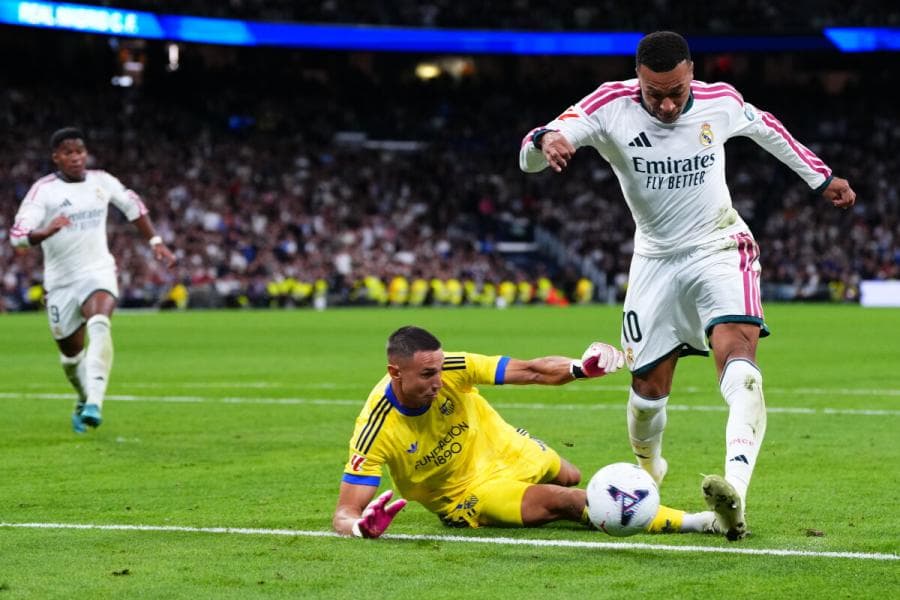
Mbappé doubled Madrid's lead with a superb individual finish. Bellingham supplied a clever backheel pass near the edge of the area, allowing the French forward to turn, evade his defender and beat goalkeeper Odysseas Vlachodimos. The goal highlighted the value of quick combinations around the box and Mbappé's ability to turn a small opening into a clear scoring opportunity.
63' — A Panenka Penalty Extends the Lead
Sevilla had a chance to make the game more competitive after the interval, including a dangerous effort from Alexis Sánchez that Federico Valverde helped keep out near the goal line. Madrid then moved from the possibility of conceding to scoring their third goal. Mbappé was brought down in the area by Andrés Castrín and converted the resulting penalty with a Panenka-style finish.
80' — Manu Bueno Gives Sevilla Hope
Sevilla finally found the net through Manu Bueno in the 80th minute. The goal reduced the deficit to 3-1 and briefly raised the possibility of a more uncomfortable finish for Madrid. It also served as a reminder that a strong attacking performance does not remove the need for concentration when defending a lead.
82' — Yan Diomande Settles the Contest
Madrid responded almost immediately. Diomande drove forward on an impressive individual run and finished with a powerful right-footed strike from outside the area. The fourth goal restored Madrid's three-goal cushion, ended Sevilla's hopes of building momentum and gave the home supporters another moment to celebrate.
The Tactical Story: How Madrid Found Space
The most revealing part of Madrid's performance was how their attacking combinations created opportunities without relying entirely on isolated dribbles. Bellingham's involvement around the first two goals helped connect midfield movement with the forward line, while Güler and Mbappé showed how quickly a move can become dangerous when a player receives the ball in a useful position.
Against a compact defensive block, the attacking team must create uncertainty. Players can move between defensive lines, pull opponents away from their preferred positions, or use quick passes to create a shooting opportunity before the defence can reorganise. Madrid found several ways to achieve this, particularly in the first half.
Güler's goal came after a rapid transition, while Mbappé's first finish followed a clever combination with Bellingham. These were different routes to the same outcome: Sevilla had little time to reset before the final action arrived.
It would be too simplistic to conclude that one tactical adjustment completely dismantled Sevilla. The goals also depended on excellent execution, individual quality and defensive decisions by the visitors. The evidence supports a more measured conclusion: Madrid's movement and technical quality were especially effective when they could attack before Sevilla's defensive shape was fully established.
Mbappé's Brace: More Than Two Goals
Mbappé's two goals demonstrated different aspects of his attacking threat. His first was a technically demanding finish created through movement and close control, while his second came from the penalty spot after he won the foul himself. Together, they showed his capacity to influence a match through both open-play quality and decisive moments inside the penalty area.
The first goal was particularly important because it arrived before half-time and gave Madrid a two-goal cushion. Rather than allowing Sevilla to remain within touching distance, Mbappé extended the advantage at a moment when the hosts were already building momentum.
The Panenka penalty was a different kind of statement. Executing a chipped penalty requires confidence and precise timing, and it completed the brace that put Madrid firmly in control. The goal also demonstrated why Mbappé remains such a difficult forward to defend: opponents must account for his movement in open play while avoiding unnecessary fouls in the box.
Still, Madrid's attack should not be reduced to Mbappé alone. Güler's opening goal and Diomande's late strike were equally important to the final result, while Bellingham's movement and passing helped create the conditions for Madrid's best attacking moments.
Why the 4-1 Scoreline Matters in the Title Race
The result arrived at a crucial point in the season, with Madrid preparing for a meeting with Barcelona. According to the reported league standings after this round, Barcelona remained six points clear of Madrid, while Atlético Madrid sat one point ahead of their city rivals. Madrid's victory therefore improved their position but did not eliminate the gap at the top.
That distinction matters. A convincing win can restore confidence, maintain pressure on the leaders and improve a team's momentum before a major fixture. It does not, by itself, change the title race into a two-team contest or guarantee that the leading side will lose ground.
El Clásico will offer Madrid an opportunity to make a more direct statement against Barcelona. The psychological value of arriving after a four-goal performance should not be underestimated, but the match will demand a different level of concentration because Barcelona can create danger through their own possession and attacking combinations.
Madrid must also balance ambition with discipline. Chasing the leaders can encourage a team to attack aggressively, but leaving too much space behind the midfield can become costly against elite opposition. The best approach will be to retain the forward movement seen against Sevilla without allowing the defensive structure to become stretched.
The Warning Sign: Sevilla Still Found a Way Through
Although the final score was comfortable, Madrid did not defend every phase perfectly. Sevilla threatened after the break and eventually scored through Bueno in the 80th minute. That moment showed why the home side cannot rely solely on attacking quality to win the most important fixtures.
Against stronger opponents, brief lapses in positioning or concentration can change the direction of a match. Madrid will need to protect central spaces, react quickly when possession is lost and ensure that their attacking players are supported by a compact defensive shape.
The response to Bueno's goal was encouraging. Diomande restored the three-goal lead just two minutes later, preventing Sevilla from building further pressure. However, the broader lesson remains that control is not measured only by the number of goals scored. It also depends on how effectively a team manages the opponent's strongest periods.
Militão's Return Adds Another Positive
Madrid also received an encouraging moment late in the match when Éder Militão returned to action after nearly six months out with injury. His appearance in the 85th minute was warmly received by the Bernabéu crowd.
A returning defender can provide an important option as the schedule becomes more demanding, although match fitness and a gradual return to full competitive rhythm remain important. His comeback was a welcome development on a night when Madrid had already secured the result.
The timing is useful for a team approaching a major domestic fixture, but Militão's return should be viewed as a positive step rather than proof that every defensive concern has been resolved.
Our Perspective: Madrid Have Momentum, but Barcelona Remain Ahead
Madrid's 4-1 victory over Sevilla offered three things at once: an impressive brace from Mbappé, a reminder of Güler's creative influence and a late goal from Diomande that turned a potentially tense finish into a comfortable result. The performance was entertaining, but its greater significance lies in the timing.
The approaching El Clásico gives Madrid a chance to turn positive momentum into a direct challenge to Barcelona. The six-point gap means the pressure remains on Madrid, and one victory does not guarantee a change at the top. What it does provide is a stronger platform from which to prepare for the next major test.
The tactical lesson is equally clear. Madrid were most dangerous when their players combined quickly, attacked space decisively and gave Mbappé opportunities to face goal. Maintaining that movement while improving defensive control will be essential against opponents who can punish mistakes more consistently.
For now, Madrid have delivered the result they needed. The real test will be whether they can reproduce the same attacking sharpness and greater defensive discipline when the stakes rise against Barcelona.
Community Debate: Can Madrid Catch Barcelona?
Madrid's win has set up an intriguing question ahead of El Clásico: is their attacking form enough to close the six-point gap, or does Barcelona still have too much room for error at the top of the table?
Madrid supporters can point to Mbappé's finishing, Güler's influence and the team's ability to respond immediately after conceding. Barcelona, meanwhile, retain the advantage in the standings, meaning Madrid need sustained results rather than a single impressive performance.
Our question for readers: will Madrid turn this victory into a genuine title-race turning point, or will Barcelona maintain their lead when the rivals meet?