UEFA Champions League Final
Porto 3–0 Monaco
Mourinho won his first Champions League title and established Porto as European champions.
Win · 3-0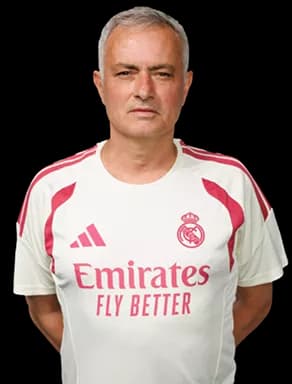
Manager · Real Madrid CF · 63 years old
 “The Special One”Since 2026
His managerial breakthrough came at FC Porto, where he won the UEFA Cup in 2003 and the Champions League in 2004.
Returned to the Santiago Bernabéu for a second spell
Returned to the club where his senior managerial career began
Returned to European competition with a major Turkish club
Won the inaugural UEFA Europa Conference League
Led Tottenham to the 2021 League Cup final
Won the Europa League and League Cup in his first season
Won the Premier League and League Cup in 2014–15
Won La Liga with a record 100 points in 2011–12
Completed the historic Italian treble in 2010
Won consecutive Premier League titles
Won the UEFA Cup and UEFA Champions League
Established himself as one of Portugal’s most promising young managers
First senior managerial appointment
Won the inaugural UEFA Europa Conference League
Won three trophies in his first Manchester United season
Third Premier League title
Won La Liga with 100 points and 121 goals
Won the Copa del Rey against Barcelona
Historic Italian treble
Retained the Premier League title
Chelseas first league title in 50 years
Won the Champions League with Porto
First major European trophy as a manager
Mourinho is known for building tactically disciplined teams that prioritise defensive organisation, compact spacing, transition efficiency and competitive control. His teams have varied considerably according to the squad and opponent.
FormationsStrengthsCriticismsEditorial scores by the Goat Arena team. They are opinion, not official statistics.
Creates compact defensive structures that restrict central passing lanes and force opponents into less dangerous areas.
Uses quick vertical transitions after winning possession, often targeting space behind advanced opposition full-backs.
Frequently prioritises shape and controlled pressure rather than constant high pressing.
Adjusts defensive height, tempo and substitutions according to the score and match situation.
Places considerable emphasis on structured attacking and defensive set-piece routines.
Often adapts his formation and pressing triggers to exploit the weaknesses of particular opponents.
High-intensity pressing, aggressive transitions and compact defensive organisation.
Physically powerful, defensively disciplined and extremely difficult to break down.
Flexible defensive systems, tactical preparation and devastating counterattacks.
Fast transitional football, vertical attacks and aggressive use of space.
Structured defensive phases with emphasis on physical midfield control and transitions.
Compact defensive organisation, direct attacking transitions and strong set-piece emphasis.
A new chapter combining his established defensive principles with the attacking quality of the Madrid squad.
Mourinho won his first Champions League title and established Porto as European champions.
Win · 3-0An iconic Champions League encounter during Mourinho’s first Chelsea era.
Win · 4-2A landmark performance in Inter’s run to the 2010 Champions League title.
Win · 3-1Completed Inter’s historic treble and secured Mourinho’s second Champions League title.
Win · 2-0A decisive Clásico victory during Real Madrid’s record-breaking 2011–12 league campaign.
Win · 2-1Delivered the Europa League and completed United’s European qualification objective.
Win · 2-0Won Roma’s first major UEFA club competition trophy.
Win · 1-0 Elena Rostova · Tactical Data Analyst
José Mourinho is one of the defining football managers of the modern era. From conquering Europe with Porto to completing Inter Milan’s historic treble, winning three Premier League titles with Chelsea and lifting the Europa Conference League with Roma, his career has been built around tactical conviction, competitive intensity and an unmistakable personality.
Mourinho builds teams around organisation, compact defensive structures, disciplined positioning and fast transitions. His tactical approach changes depending on the available players and the opponent, but his teams are usually designed to be difficult to beat.
At Goat Arena, Mourinho represents a particular definition of managerial greatness: winning across different countries, adapting to different squads and delivering major trophies in knockout competitions. His legacy also invites debate about the balance between defensive control, attacking freedom and long-term squad development.
Mourinho changed the modern conversation around tactical preparation, defensive structure, psychological management and the public personality of football managers. His career includes extraordinary highs as well as controversial departures, making him one of the sport’s most discussed coaching figures.
Mourinho won the UEFA Champions League with two different clubs: FC Porto in 2004 and Inter Milan in 2010.
Statistics are cross-checked against more than one source where possible. Figures can differ between providers. See our Editorial Policy.